Videos
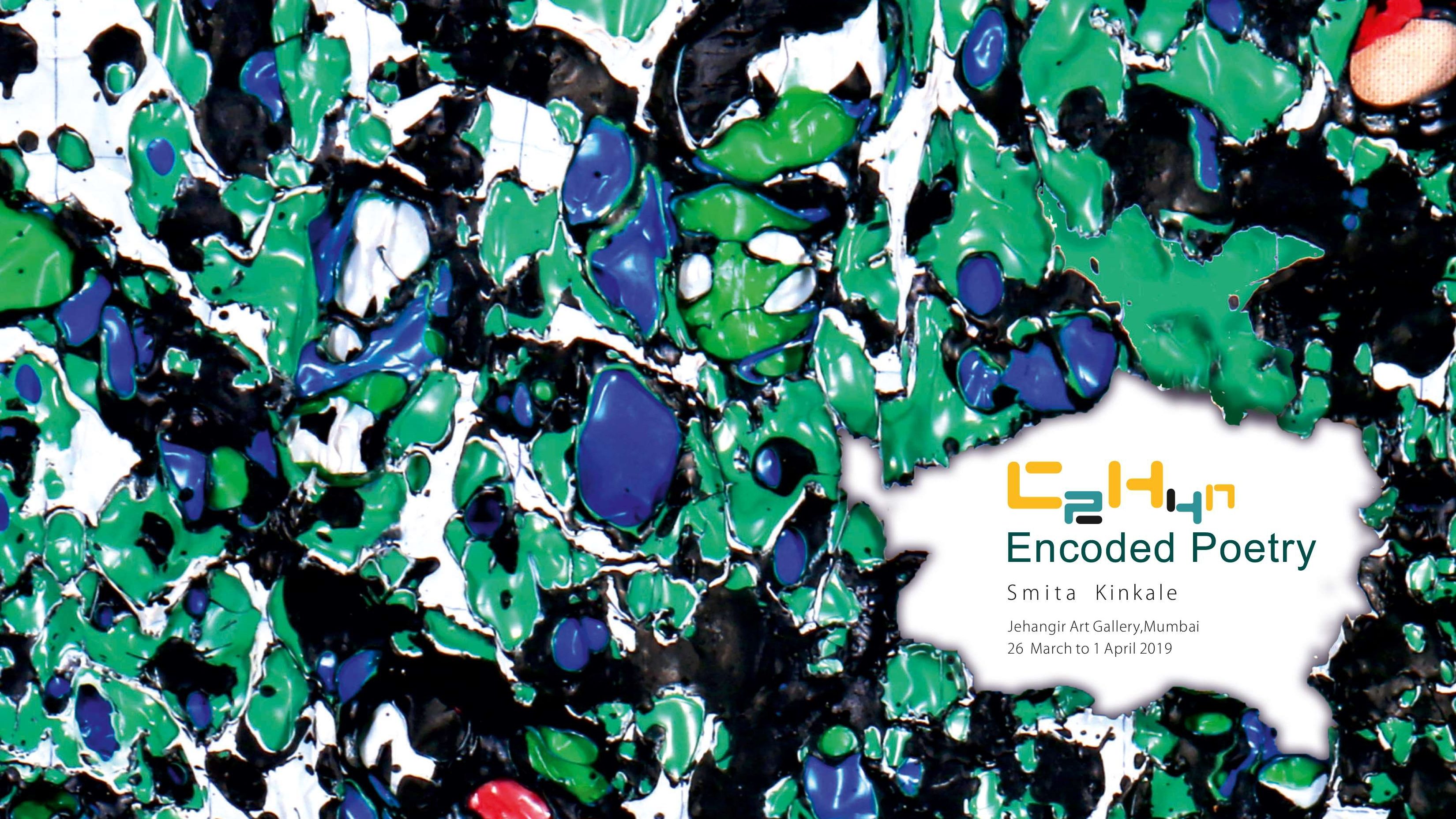
C2H4n Encoded Poetry
A Poem in Process ….
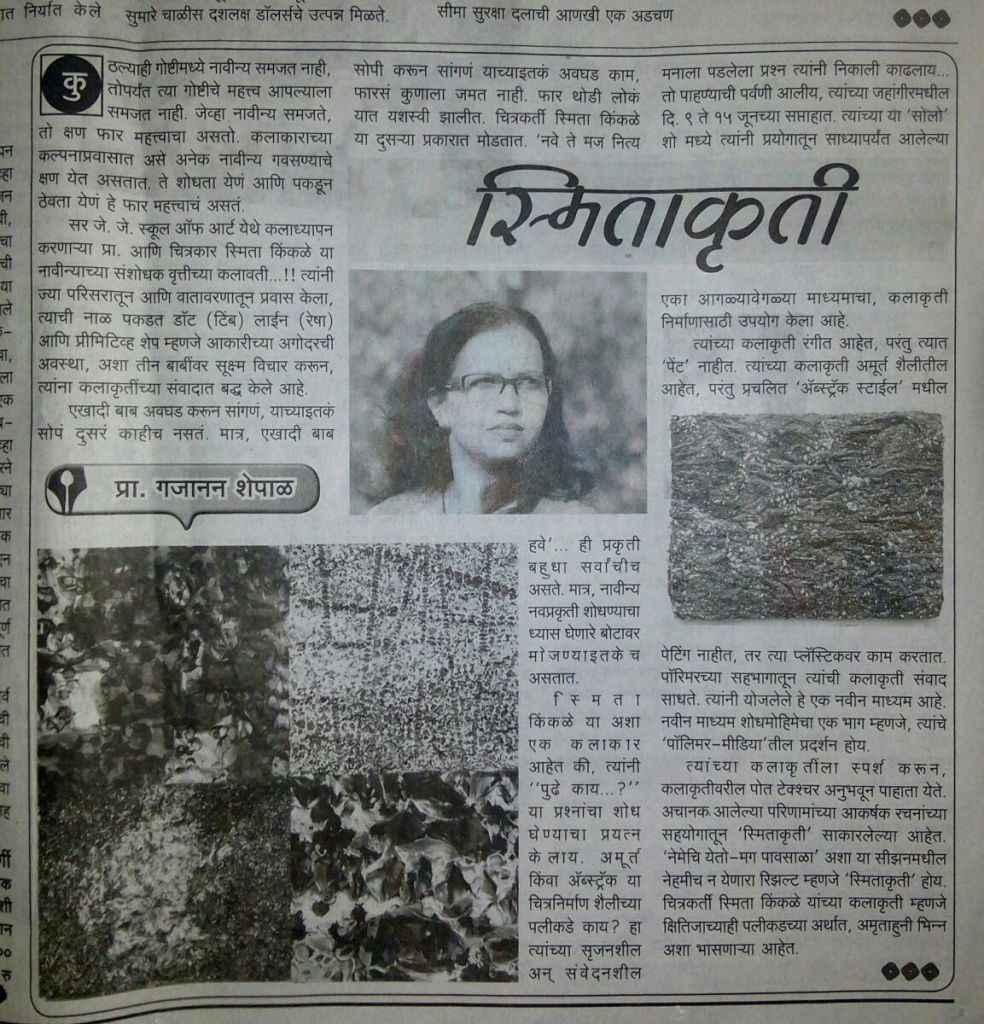
Sir JJ School of Art, a 160 year old art-education institution in Mumbai, has a history of its own Abstract Art dating back to 1950s. This is where Smita Kinkale was a student and for a decade now, has been a teacher. The tradition of abstraction that this institution has cherished is about total absence of form, where artistic expression is inherent in application of paint ‒ oil or acrylic- on canvas. Smita Kinkale’s departure from this tradition has now been a thing of the past for her, as her second solo show in Mumbai tends to affirm this tradition, rather than to negate it. When Smita Kinkale negated the canvas and chose polyethylene, the choice was more out of her response to her
immediate surroundings and not as a rebellion. Indeed, she represents a generation that prefers being true to oneself than indulge is rebellions. Hollowness of what was seen as hegemonic in the past is so evident post millennium, that the artist feels no need to say it is hollow. Instead, s/he charts an alternative path of her own. Smita did just that. Abundant, countless sheets, made of the C2H4 substance was the first thing she noticed when she left her maternal home that was in the protected forest of Tansa in Thane district, and began studying in Mumbai. Plastic or polyethylene was there in the tribal belt of Tansa too, but its all- pervasive presence was felt in a metropolis. Smita chose to experiment with this intriguing material, and has remained with it since more than a decade now. The process may sound violent to some, but is somehow intricate and delicate. The artist spreads sheets of polythene on one another, she charts our some geometrical patterns on these sheets together, by cutting them with a blade. Sometimes, these very cuts would be potent enough to take shapes of crafted patterns. Once this initial work is done, she torches up a roll of black polyethylene and lets it’s flame touch the sheets below. The sheets now become one, and the black fire-brush leaves its marks on them. The artist decides whether to keep her steady and firm hands moving , or to stop for a while. She might have taken a roller in her hands, and a canvas to be painted with it, like many of her predecessors did. Or palette knife, or thick brushes, as many other abstract artists from Mumbai did. A thick roll of polythene , instead, gives those tiny dots and trenches into the layers of sheet. Poetry begins here…
Demonized as it should be, plastic or polythene is a major pollutant on our planet. Nearly five trillion plastic bags , or 1,60,000 per second, are used by humans , whereas hardly one percent of these use-and -throw plastics is recycled. The sheets that go into Smita Kinkale’s work, if not used here, would have gone for packaging, for making bags,for rain-covers of some kind. Smita began with the idea of recycling them, but soon realized the possibilities of this medium. She then decided to use new, mostly unused sheets. While the earlier works could be seen as having some oblique ‘message’ of recycling, the works that she preferred to exhibit in her solo didn’t have such external consideration. Instead, she concentrated on thinking of the colours, the textures in her work, like any other abstractionist would prefer. The elating effects of the chosen surface began here, once all external considerations were put to a halt. Her earlier works reminded the viewer of sights in nature : a Gulmohur ( delonix regia) tree, Lavenders and jacarandas, a blue lake or lush green fields. The artist insisted that these are essentially a viewer’s readings. In 2015, she gently turned down the suggestion of titling her works after these natural sights. Smita Kinkale’s manifold affiliations to the Mumbai school of abstraction have to be pronounced in her second solo show. The artist may not agree, or may not even bother about these links; thinking that her chosen path is different. Yet the parallels have to be drawn, between her path and that of the Mumbai tradition of abstraction in art. Textures and forms are not desired by the artist, but are seen as a result of her/his meditative, prolonged and repetitive act of doing. The very act, the process of doing, is the search of nothingness. Sometimes the artist laments for the absence of a landscape in his desire, the landscape of nothingness. The colour is a state of mind. And not more. Smita Kinkale’s work displays these concerns more often now than before. Not only she knows her medium well, she knows what she was waiting for, from her works. The challenges to comfort zone are visible in new processes like gently tearing a layer off, to make the undercurrents felt. The medium might have it’s own limitations. A polyethylene sheet, to say the least, is a prduct of chemical and industrial processes. Smita Kinkale’s attempt has been to reclaim this ready-made, to undo its surfaces and to make visible the poetry within it. With her consistent practice, Smita Kinkale is sure to claim her rightful place in the history of Mumbai School ofAbstraction that emanated from The JJ School of Art.
-Abhijeet Tamhane, Mumbai, March 2019
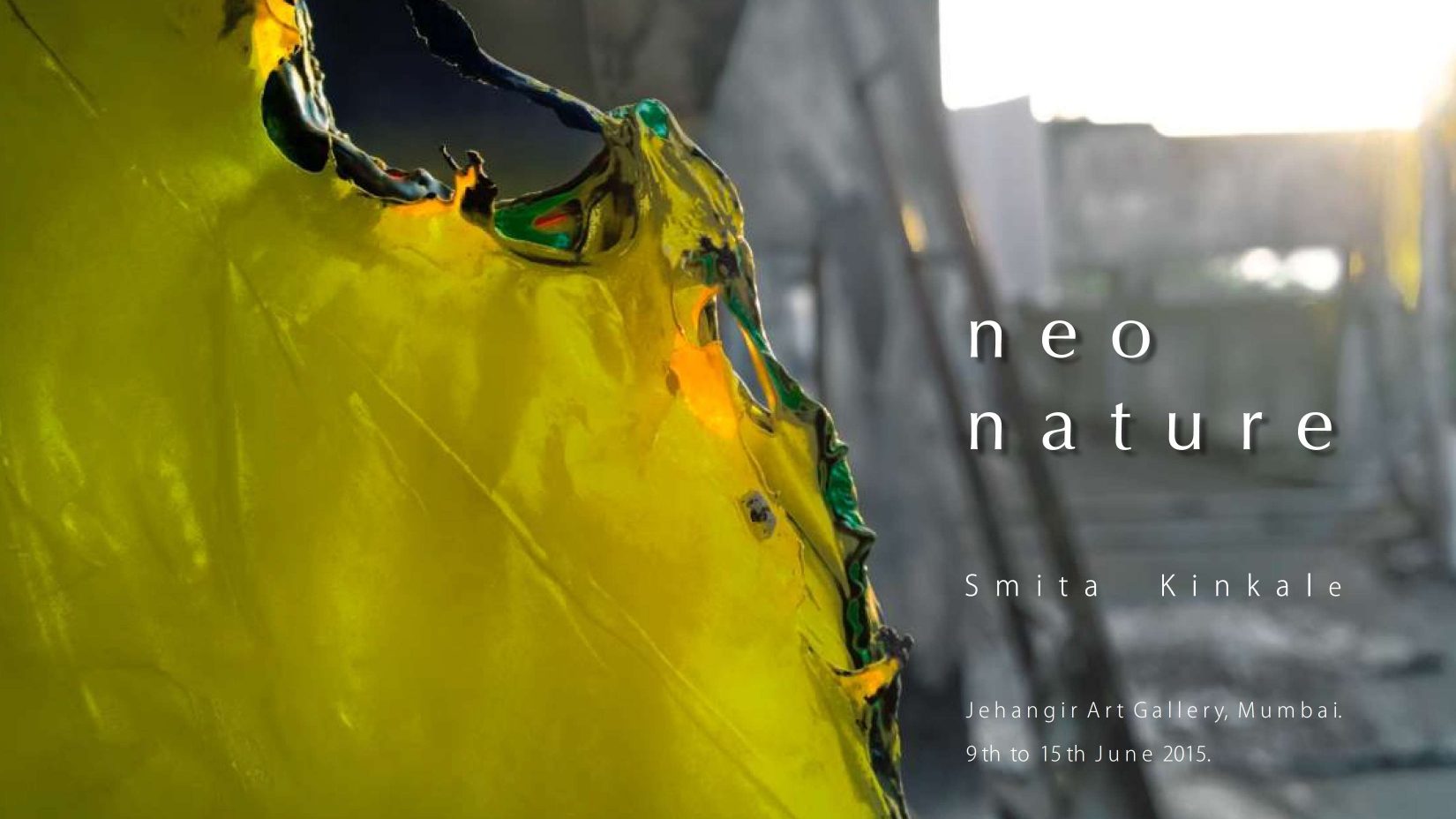
NEO NATURE
OF WOUNDS AND WINDOWS.
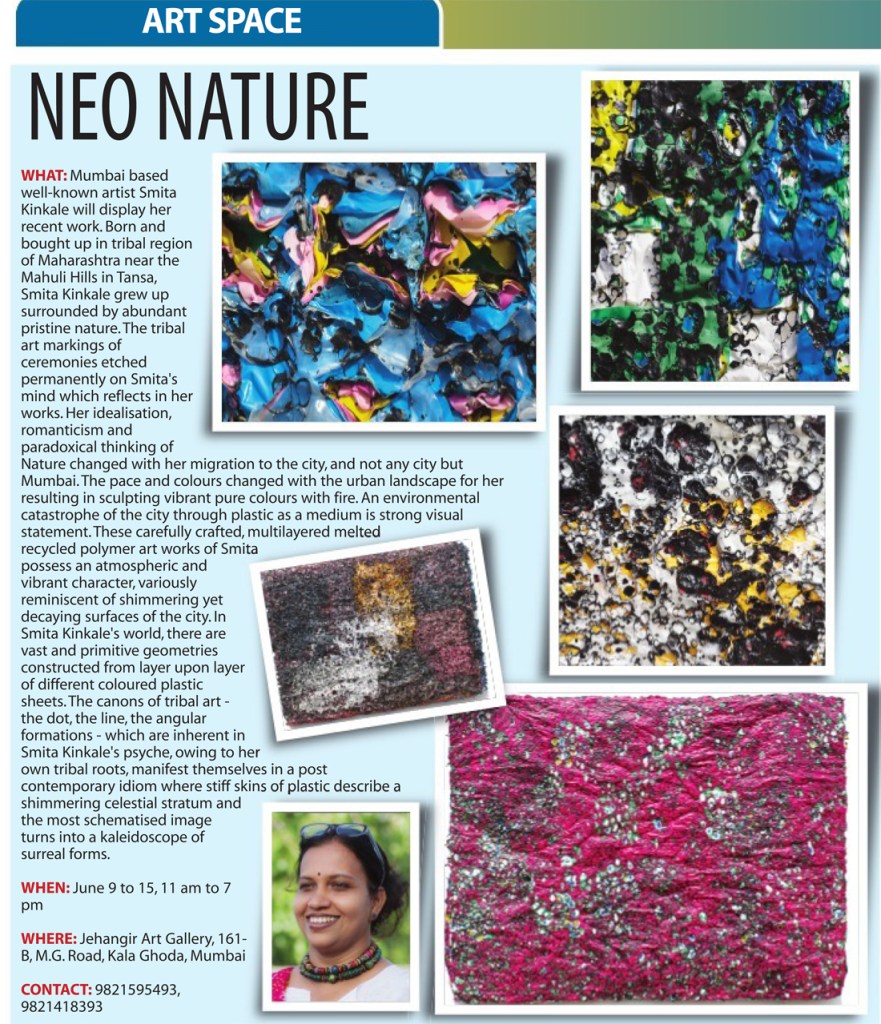
There are worlds within worlds just as there is a vortex of images programmed within us which collaborate with those, without. In Smita Kinkale’s world, there are vast and primitive geometries constructed from layer upon layer of different coloured plastic sheets. A medium as inane and vulgar as plastic is harnessed into a marvellous fabula ~ a gleaming cityscape, a magical doll’s house full of open and shut windows. Immense membranes of pink, purple, blue and green plastic sheets peel, unfurl, reveal, collapse and unravel their innards so that the viewer is mesmerised on the one hand, to watch its magnificence and to marvel at its cosmic scale and on the other, be drawn into its mico elements and wonder if those sockets of ripped plastic will ooze blood in that very moment. These works are veritable two dimensional sculptures and once they are metamorphosed, they are very remote from their fundamental medium. An almost cathartic sense seems to take over. The canons of tribal art ~ the dot, the line, the angular formations ~ which are inherent in Smita Kinkale’s psyche, owing to her own tribal roots, manifest themselves in a post contemporary idiom where stiff skins of plastic describe a shimmering celestial stratum and the most schematised image turns into a kaleidoscope of surreal forms.A window is the smile of a house; open: it reveals the sunshine within shut: it hugs itself to sleep.
– Anahite Contractor May 2015.
OVERCOMING LOSS
Before one touches down at any of the two airports, dinghy houses with roofs wearing plastic sheets is the first thing that one can notice. Some 100 kilometers off the metropolitan limits, Adivasis in Tansa and other protected forest areas use these very sheets as a rain cover on their bodies. Thus in the regional context, a single large sheet pf plastic is a ready-made object primarily used for protection. Smita Kinkale knows the purpose and usefulness of these sheets, and her larger artistic project has been about replacing the function, purpose and utility with an aesthetic statement. A statement that connects her memory and present situation to her own aesthetic joys. Smita’s art-making practice looks differently at the notions of craft and artistic intervention at one end and the conceptual context of “the ready-made” on the other. While craft is integral, what is important in the work is memory and imagery. To be sure, these works made with plastic sheets do not land you in Mumbai but they would rather take you on a flight to distant, often imagined lands that belong at best to the realm of memory.With her own upbringing in Tansa forest area as an Adivasi girl, she remembers moods of the forest, the many rain flowers that punctuate meadows that go green in monsoon but would turn golden brown in October and show the bear black soil in summer. While these wildflowers and monsoon orchids are a part of Smita’s imagery. Arguably, it is not a coincidence if a viewer, looking at Smita’s work, is reminded of Jackson Pollock’s “Lavender Mist”. Smita’s inclination toward the bygone American art movement- abstract expressionism- of which Pollock was an exponent nearly half a century ago, is surely different, as she refuses the use of paint.Spreading the plastic sheets on one another, welding them to make a multi-layered picture-plane and then excavating hidden layers from the picture-plane are studio processes that define Smita’s intervention that is intrinsically artistic. She chooses the layers that inform each different picture-plane, and with some defined cuts with a knife or scalpel, she operates one the picture-plane to make her clues visible.Smita stops at giving some clues. Some may think of the red work as a Gulmohur or others might think of it as bougainvillea, yet others might not think of any flower but will arrive at a joy of witnessing the red abundance. Same with the blue works that delve the viewer into aquatic ecstasies, or the white works that reveal a riot of colour.Multilayered as it obviously seems, these works pave pathways to a multilayered experience for the viewer.
– Abhijeet Tamhane, Mumbai, summer 2015.
Catalogue
( Click to view )
Press


Videos
 Kinkale Studio